Does the failure to intervene as a bystander constitute as an evil inaction?? This statement was put forth in Zimbardo (2008) when he was discussing what occurred after the experiment had wrapped up. Several of the “good” guards did not intervene when the prisoners were being abused, and similarly, the prisoners did not intervene when they watched someone else being abused (Zimbardo, 2008). This question leads me to think: Does evil not have to be concrete actions but simply not doing something to stop these actions from occurring?
The bystander effect has been a phenomenon for many years. Ever since the famous Kitty Genovese case, where her neighbours all witnessed or heard her being murdered and did not do anything about it, thinking that others would. Do you think that this makes the bystanders just as bad as the murderer? I personally do not. I perceive these inactions as harmful, and I do see this as a form of evil. This does not take away from the murderer’s action being more evil and harmful to the individual and society, though. Further, the bystander effect may be fixed by such things as education.
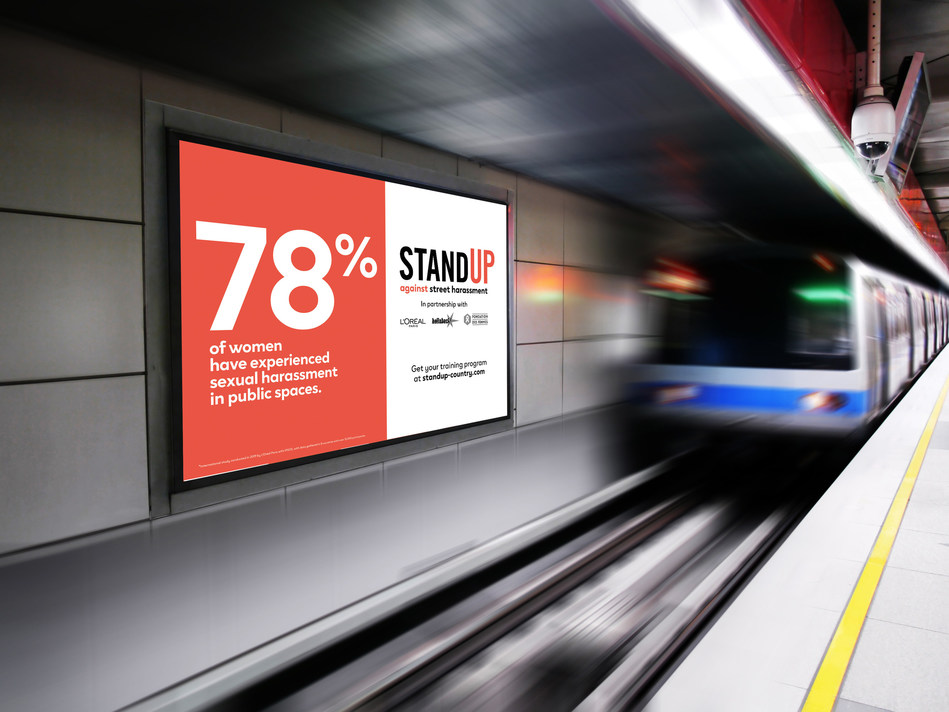
As I am writing this, it is International Women’s Day. In light of this, it is important to see that the bystander effect does not have to take on such extreme forms as in the Stanford Prison Experiment, but everyday occurrences. Street harassment is one example of this and has occurred in 78% of women interviewed (L’Oreal Paris, 2020). Further, out of the 15,500 interviewed, only 25% of victims had someone else intervene and 86% of people did not know what to do to intervene (L’Oreal Paris, 2020). This famous company is starting a campaign called Stand Up, which will train people on bystander intervention to help defuse situations and make public spaces safer, especially for women (L’Oreal Paris, 2020). This demonstrates that many individuals experience harassment, which can be seen as a form of evil, and the inaction of not aiding these victims is not necessarily because people do not want to, which is the evil part, but because they do not have the proper education. This makes me change my perception on the bystander effect being an evil inaction a little bit more, as there is more to it than just not wanting to stand up for what is right and goes back to the education of the public on a wider level.
With this in mind, education is clearly key in fixing this issue. Santacrose, Laurita & Marchell (2020) conducted a study with undergraduate students who watched a video called “Intervene” about student’s intentions when when intervening on behalf of someone else in a number of different situations. They were conducting this study to see if it was an effective method of increasing student’s likelihood in intervening in situations (Santacrose et al., 2020). It was discovered that even after a 4 week period, these students would intervene in negative social situations (Santacrose et al., 2020), showing that interventions like these can aid in lessening the effects of inaction. Clearly, just watching an evil action occur is bad enough that educating the public needs to happen. Does this make these inactions evil, though?
Based on this information gathered, as well as what we know from the Stanford Prison Experiment, doing nothing can be considered evil. I believe that these inactions are one example of acting “evil” and to educate the public on how to change is key. On the other hand, perhaps this could lead evil acts to be pursued in the future though if people see they will not be stopped? Just some things to think about!
References:
L’Oreal Paris. (2020, March 6). L’Oreal Paris Launches International Training Program: Stand Up Against Street Harassment. Retrieved from https://www.prnewswire.com/news-releases/loreal-paris-launches-international-training-program-stand-up-against-street-harassment-301018514.html
Santacrose, L. B., Laurita, A. C., & Marchell, T. C. (2020). Intervene: Modeling Pro-Social Bystander Behavior in College Students through Online Video. Health Communication, 35(4), 397–409. https://doi-org.proxy1.lib.trentu.ca/10.1080/10410236.2018.1564956
Zimbardo, P. (2008). The Lucifer effect: Understanding how good people turn evil. New York, NY: Random House Trade Paperbacks.
 Harper's Psyc 4720 Blog