Something that stood out for me in the readings this week was the discussion about serial killers. For many people, they see serial killers as extremely evil, and this is also portrayed in many television shows and movies within the past decades. The impulses one feels to be angry can be resisted which is why there are serial killers (Baumeister, 1999), as these individuals do not just go out on a killing spree but kill for their own means as their victims have something in common, as part of the definition. This definition is as followed: “A person who commits a series of murders, often with no apparent motive and typically following a characteristic, predictable behaviour pattern.” (Oxford Dictionary, 2020). Serial killers initially came out of ordinary people committing these acts in films, such as Alfred Hitchcock’s Pyscho (Baumeister, 1999). Before this, killers were thought of as monsters such as werewolves or vampires. Further, these individuals get away with the act initially which allows them to escalate the situation, and be able to discover further pleasure in this (Baumeister, 1999). I thought this was especially interesting as this is still shown in television shows and films to this day, and if this could be what provokes other people, why do we watch these things to the extent we do????
One of the most instrumental serial killers that has been seen in more detail as of lately is Ted Bundy. Ted is one of America’s most well-known and prolific serial killers as he killed at least 30 women, and possibly more, during the 1970’s in a horrific manner. There recently have been a documentary series “Conversations with a Killer” as well as a movie “Extremely Wicked, Shockingly Evil, and Vile” about his life and killings, that debuted on Netflix. Now, I will admit to watching both of these but it got me thinking about some things. He got away with this for such a long time and seemed to enjoy it, which could provoke others to do the same as they watched this carry out for so many years. Having these acts documented and seemingly glorified may add to individual’s abilities to commit similar acts as they saw a type of fame that came out of this and saw that they may be able to get pleasure and recognition. This comes back to the ideas in Baumeister (1999) book on how ordinary people in movies committed these acts and it allowed people to think they could do the same.
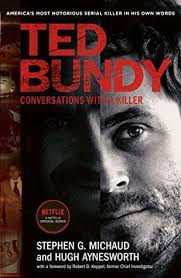
Further, the way the media portrays serial killers around the world have differing effects. Wiest (2016) stated that many serial killers are portrayed in the media as either a monster, with animal characteristics or a type of celebrity, where in the last few decades people see serial killers such as Ted Bundy as charming and handsome. This study compared UK’s view of serial killer and America’s, and found that the United States put more concentration on the serial killer instead of the victim (Wiest, 2016). This could contribute to other’s seeing the fame they could achieve and choosing to act this way as well. The United States also sometimes directly mentions the celebrity status of these individuals and mentions records they hold, such as killing the largest amount of people. The UK also reports on a majority of the serial killers in America. Due to the large numbers of serial killers that come out of America, could it have something to do with how sensationalized they are?? I think so, as they are treated like celebrities and given an extensive amount of recognition for their acts, as Ted Bundy experienced.
Overall, I see the fact that serial killers have been dramatized and sensationalized as a large problem, and this directly related to Baumeister (1999) statement on the coming out of ordinary people committing these acts in film. With us constantly watching movies and documentaries on this, does this encourage the celebrity status serial killers experience?? Something to think about!
References:
Baumeister, R. (1997). Evil: Inside human cruelty and violence. New York, NY: W.H. Freemand and Company.
Wiest, J. (2016). Casting Cultural Monsters: Representations of Serial Killers in U.S. and U.K. News Media, Howard Journal of Communications, 27:4, 327-346, DOI: 10.1080/10646175.2016.1202876
 Harper's Psyc 4720 Blog
Hi Harper!
They way you described serial killers being sensationalized and dramatized in popular culture makes so much sense. I don’t think many people stop and think about it like you did here. For some people, this may be something they might dream about but could never bring themselves to actually commit murder, so instead they settle on what is portrayed in the media to satisfy their dark desires. I think part of the reason why so many people are attracted to these documentaries is the actors who are involved. For the series on Ted Bundy, Zac Efron (Hollywood sex symbol) portrayed him. By having attractive actors like Zac Efron, the media is almost handed the opportunity to glorify the killers. Which makes sense why victims do not get as much attention like you mentioned. I think another reason would be just plain curiosity that unfortunately leads to people becoming obsessed with learning about the lives of serial killers. Great post!
LikeLiked by 1 person
As much as I want to agree that sensationalizing Serial Killers influences people to go and kill, because I hate hearing about the killers instead of the victims, let us take this back a step. Parents used to think that violent video games and movies made their children aggressive and violent, when in reality aggressive children were more attracted to violent video games and movies. So maybe it isn’t hearing about the achievements of serial killers that make people more likely to kill, but more aggressive people being more attracted to that kind of fame and recognition. Let me know what you think!
LikeLiked by 1 person
This is a really good point! I definitely agree with you. The video game example was a really good way to examine that as well. I think that those with the predispositions or aggressions could be attracted to the fame that comes with being a serial killer. I think that when it comes to serial killers, both could be a reason. That maybe some see the achievements as an attraction and some see the fame as an attraction, and then maybe some see both. I think this would be an interesting area to do more research on as there are so many examples and theories as to why. Definitely agree with you, and it is making me think a lot more about it! Thanks!
LikeLike
Hi Harper,
I think that your takeaway from this week’s discussion is very interesting. As someone who is very interested in serial killer documentaries, I often ask myself whether I am giving these evil individuals the attention they wanted in the first place. I think that the fascination society has with these heinous acts is bad and potentially contributing to the problem of deviance and violence. To add onto what you’ve discussed here, I wonder if there is a way to stop this sensationalization of murder and violence from being so ingrained in our everyday lives, or if we are too far gone. Good post!
LikeLiked by 1 person
This is Kayla, not sure why my user name isn’t posting!
LikeLiked by 1 person